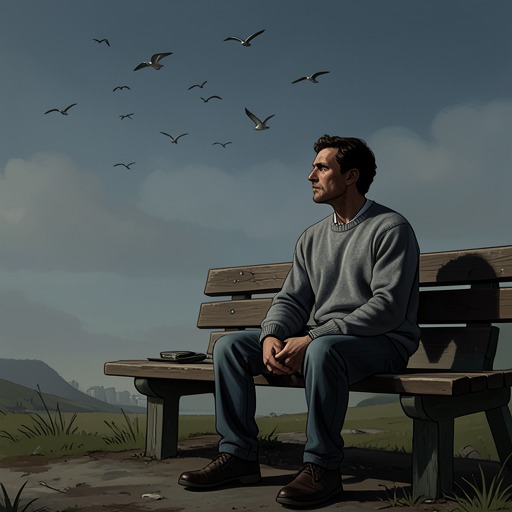
Isaac escapes from Walmart after taking supplies
American RustIsaac English’s escape from Walmart turns a desperate attempt to meet immediate needs into a public pursuit. He enters the store exhausted, eats, and briefly falls asleep; then, lacking a coat and uncertain where he is, he decides to take what he needs rather than face another night exposed. The theft is improvised and deliberate, but the escape depends on a sudden opening: when the greeter steps aside, Isaac makes it through the doors and runs into the woods.
Need, Hunger, and Disorientation
The scene begins with Isaac moving slowly across the parking lot toward the lights and signs of a Walmart. Once inside, he pauses in the blast of warm air, then notices the greeter watching him. His first calculation is not how to get away but how to recover enough strength to continue. He wants a quiet place to sleep, but decides that he must eat first and chooses a cheap meal from Taco Bell: two bean burritos and a taco, selected for their calories. Even this small decision is presented as practical planning. He sits with a glass of water and eats slowly, nearly too tired to manage the food.
An old woman at the next table wakes him by telling him that he has fallen asleep. Her intervention forces him to reckon with what comes next. A shelter occurs to him, but he believes it is the first place people will search for him. He thinks of himself as a vagrant felon and recognizes that he lacks both a coat and a clear sense of where he is. The store cannot offer lasting refuge either; it will eventually close, leaving him where he began. His decision to act follows from this narrowing set of choices: he will take supplies from the store.
Gathering Supplies
Isaac pushes a cart through the aisles while easy-listening music plays. Other customers focus on their merchandise as he passes, a response he reads as embarrassment at looking directly at him. He recasts the theft as resource gathering and self-improvement, imagining a new beginning built from what he can carry. The contrast between the store’s abundance and his immediate deprivation gives the scene its pressure: coats, soap, food, and clean clothes are ordinary merchandise to shoppers, but potential shelter and preparation to Isaac.
He first collects a razor, travel-sized soap, shaving cream, and deodorant from the pharmacy aisles. He adds energy bars, recognizing them as the same kind Lee English eats, then takes a four-inch hunting knife from a wall of blades in the sporting-goods section. In clothing, he chooses clean pants, a button-down shirt, socks, underwear, and a pack of T-shirts. He also takes the thickest coat available, a heavy, blanket-lined canvas garment, and a fleece, as well as hats. His selection is both immediate and forward-looking: food and warm layers address the present, while grooming supplies, spare clothes, and a knife serve an imagined future in which he can prepare for himself.
At the checkout, Isaac waits behind a man talking on a cellphone. He judges himself small and unthreatening and hopes that the people around him have plenty else to notice. The employee who has been watching him eventually goes to do something else. Isaac then abandons the queue and pushes the cart toward the dressing rooms, shifting from waiting to action as the chance to pass unnoticed opens.
Exposure and the Run
In a locked dressing room, Isaac piles the loose goods onto the coat and strips completely. Facing the mirror, he sees a sickly, filthy-haired, unshaven young man, his appearance underscoring how far the imagined self-sufficient figure is from the body that needs help. He puts on the new clothes and then layers his old clothes over them, concealing the change as best he can. He puts the knife at his belt, the soap and razor in a pocket, and energy bars in his jacket. Carrying the coat on his shoulder, he leaves the room and walks toward the exit, already sweating under the extra clothing.
The attempted exit is interrupted when a woman calls after him and tells him to pay for the coat. Isaac does not turn around. He keeps moving toward the doors, hears the request repeated, and then hears people yelling as an announcement calls employees to a code seventy-six. The scene’s movement changes abruptly: the quiet, calculated work of assembling supplies gives way to a chase. Someone runs in the corner of Isaac’s vision, and he runs too.
The store greeter, an old man in a blue vest, is the last person between Isaac and the door. They look at one another as Isaac charges toward him at full speed. The greeter steps aside. Isaac stumbles against the doors and loses ground, but gets out into the parking lot. He runs past idling cars and other shoppers, hears footsteps close behind, and aims for the wooded area at the lot’s edge. A hand brushes his coat; someone falls behind him, but he hears another pursuer. He considers pulling the cart to slow them, then rejects the idea and continues without it.
Escape and Significance
At the curb, the footsteps slow and stop. Isaac jumps over the high curb, plunges into the grass, and runs downhill, keeping his footing despite the risk of falling. He reaches the woods and continues into the darkness. The escape is physical and immediate, not a resolution of the insecurity that brought him into the store: the clothing and supplies are with him, but he remains a fugitive moving without a known destination.
The episode turns the familiar retail sequence of browsing, selecting, and paying into an improvised survival exercise. Isaac’s internal language gives his actions a mock-heroic scale, casting a hungry, visibly depleted young man as a maker of preparations and a figure on a mission. That self-mythologizing does not erase the material facts. He needs food, warmth, clean clothes, and sleep; he takes those necessities under observation and flees when challenged. His success hinges not on mastery of the store but on a brief human gesture at its threshold, when the greeter moves aside and the woods become an available route out.